Black Friday week
📄 Digital book in PDF · read it on your phone or print it
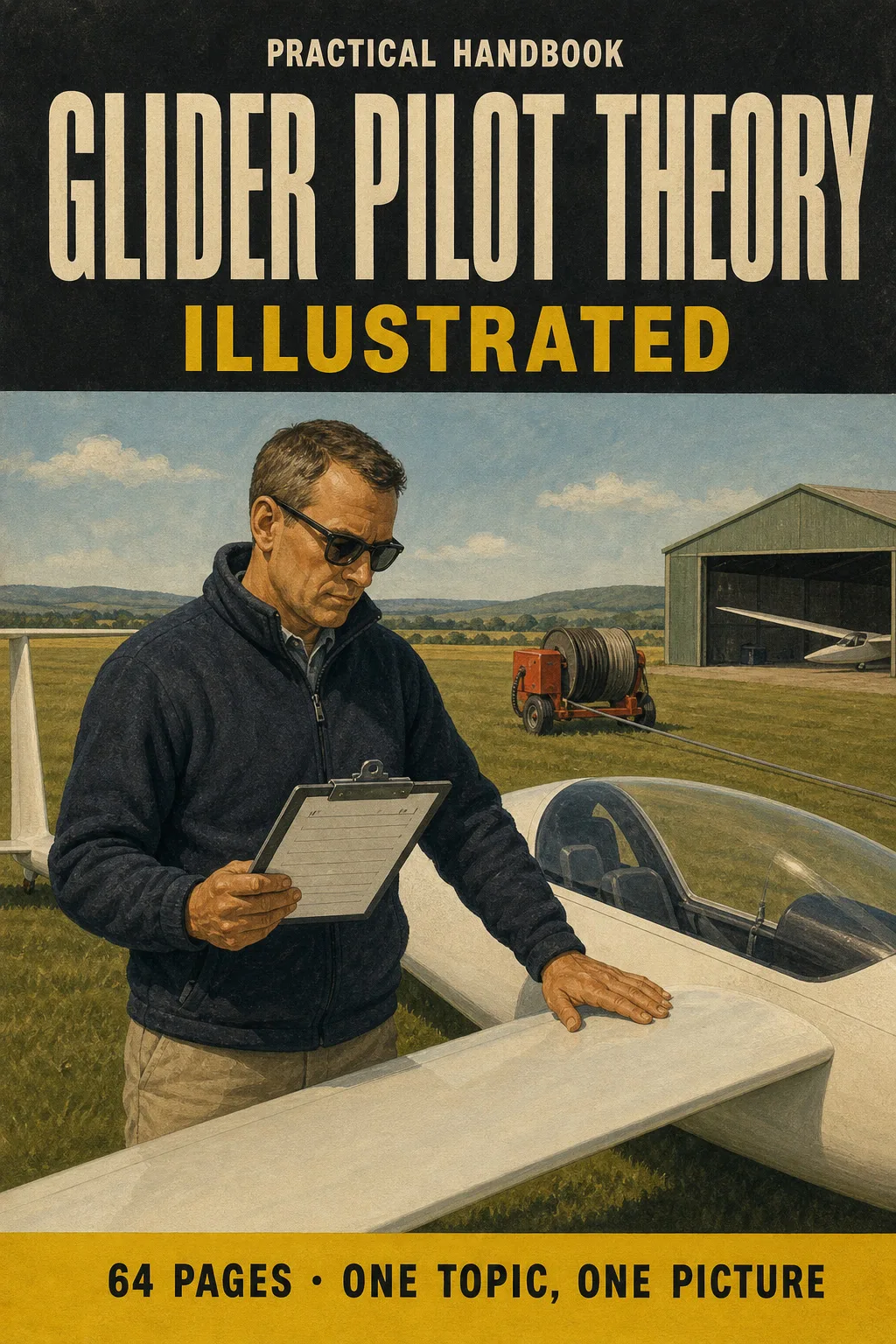
How a glider flies, the polar curve, winch launch and aerotow, launch failures, thermals, ridge and wave, UK airspace, weather and navigation. Each topic has its own page: the drawing first, then what you need to remember. 64 illustrated pages.
🔒 Secure checkout · PDF by email · 30-day guarantee
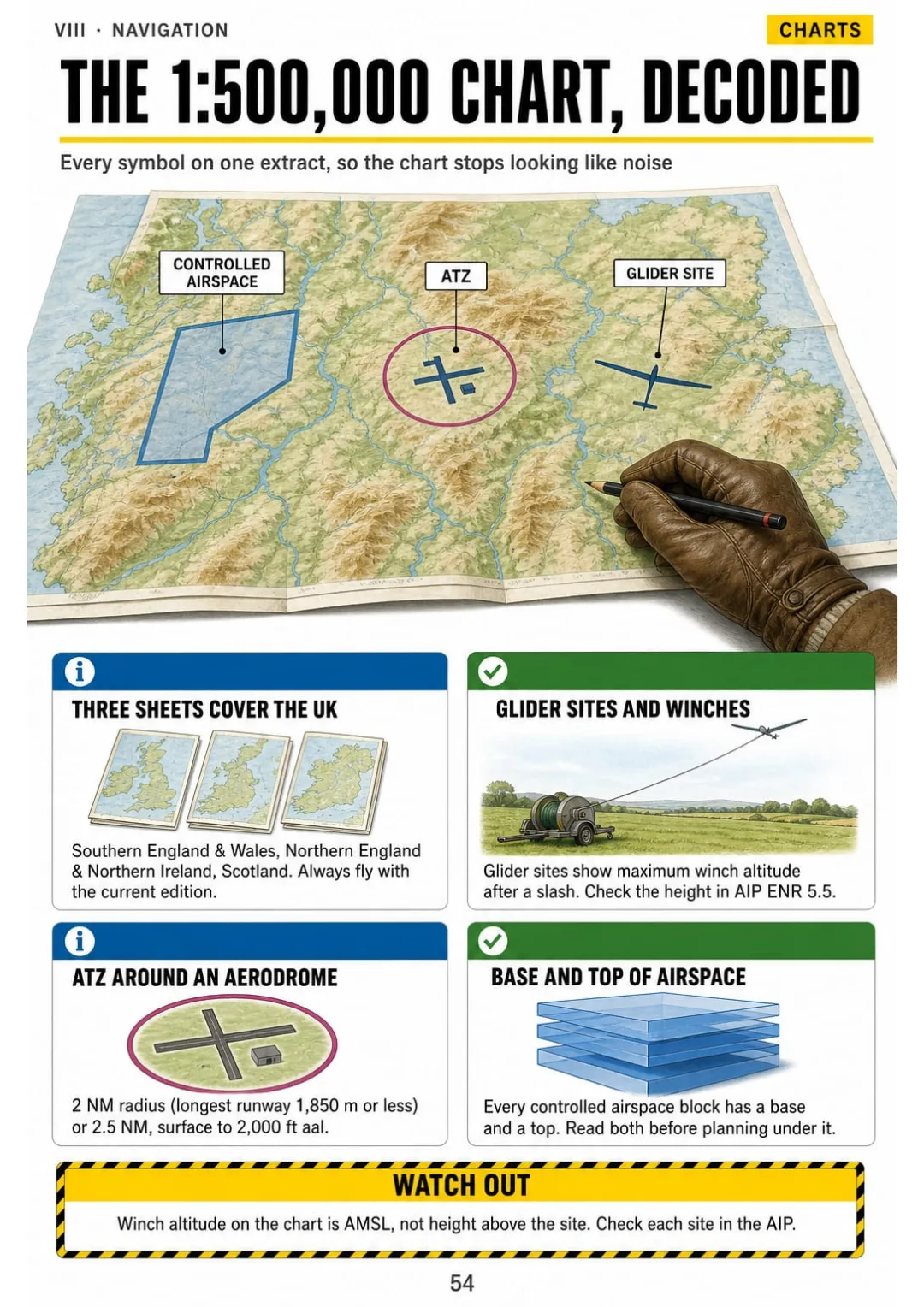
Every page has one big drawing and a box with the numbers and steps you need to know:


Swipe to see more →
These are real pages from the book. The table of contents is the full one: 9 parts and 60 topics.
It's Sunday at the club. Your instructor holds up the polar for the club two-seater and asks: "So where's minimum sink?" Everyone at the briefing waits.
You read that chapter twice this week. But the manual explains the curve in three paragraphs of axes, sink rates and tangents, and words don't draw a curve in your head.

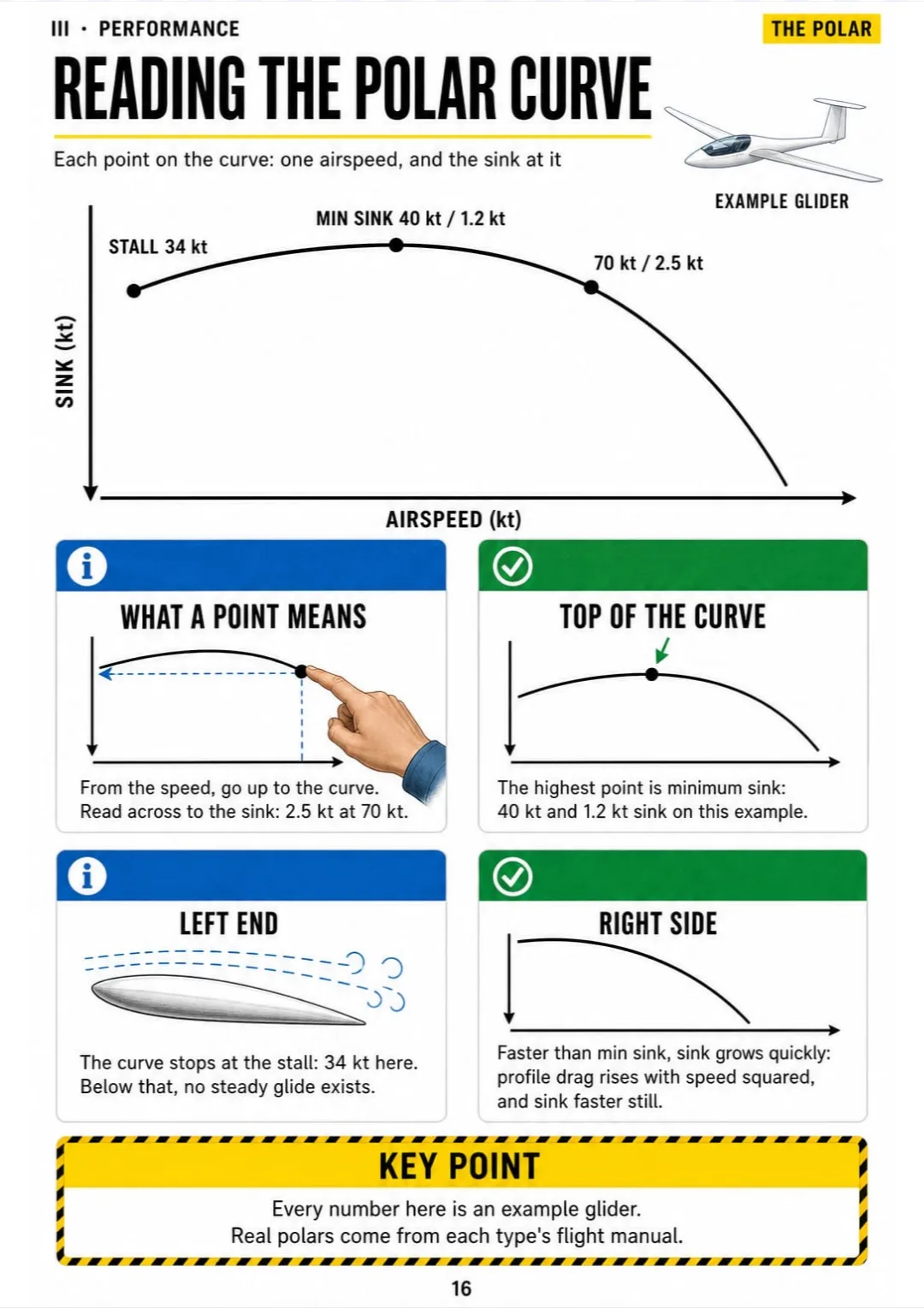
In the book the polar curve is one page: the curve drawn large, the stall at its left-hand end, minimum sink marked at the top of the hump, and a dotted line showing how to read the sink rate at any speed.
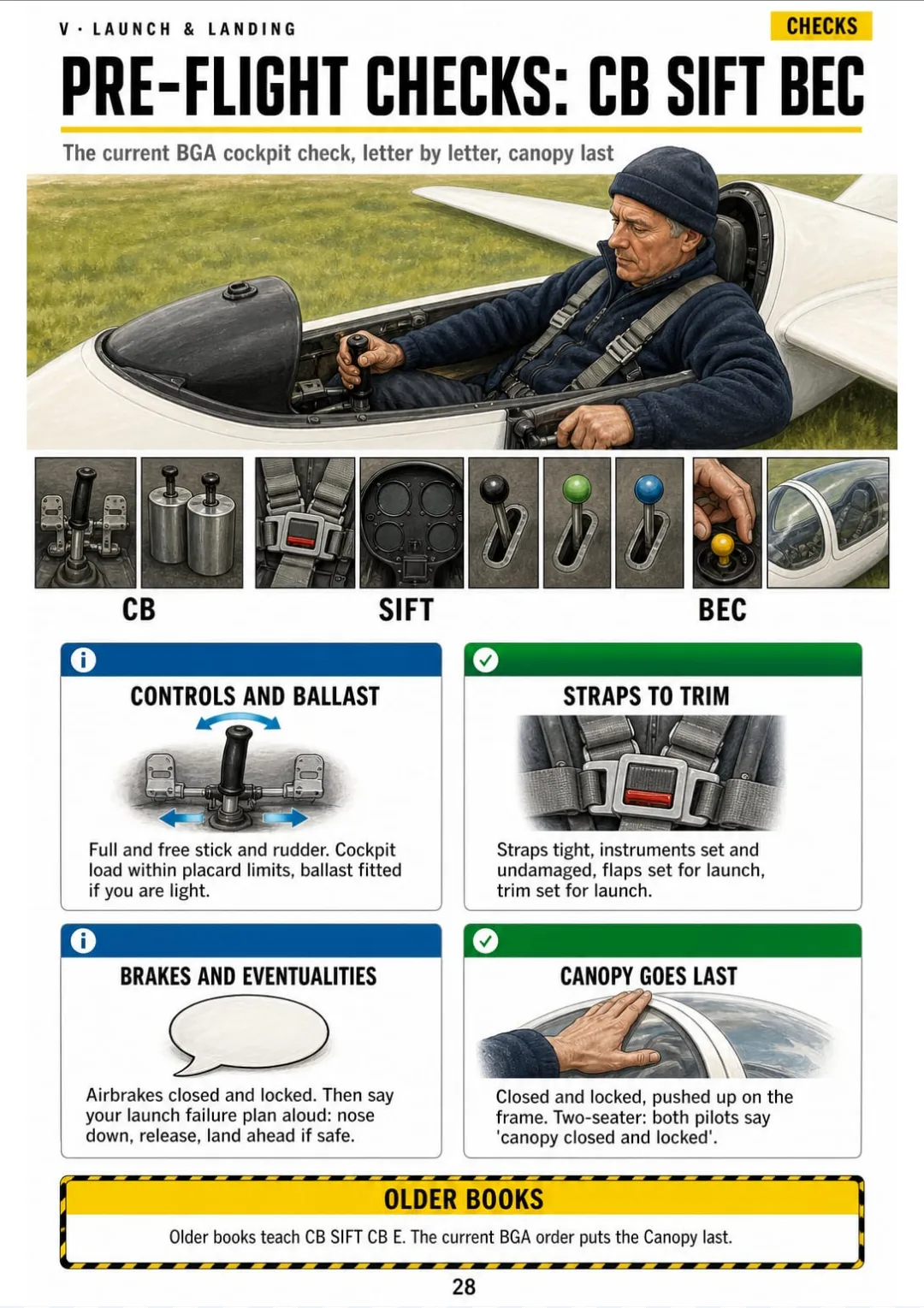
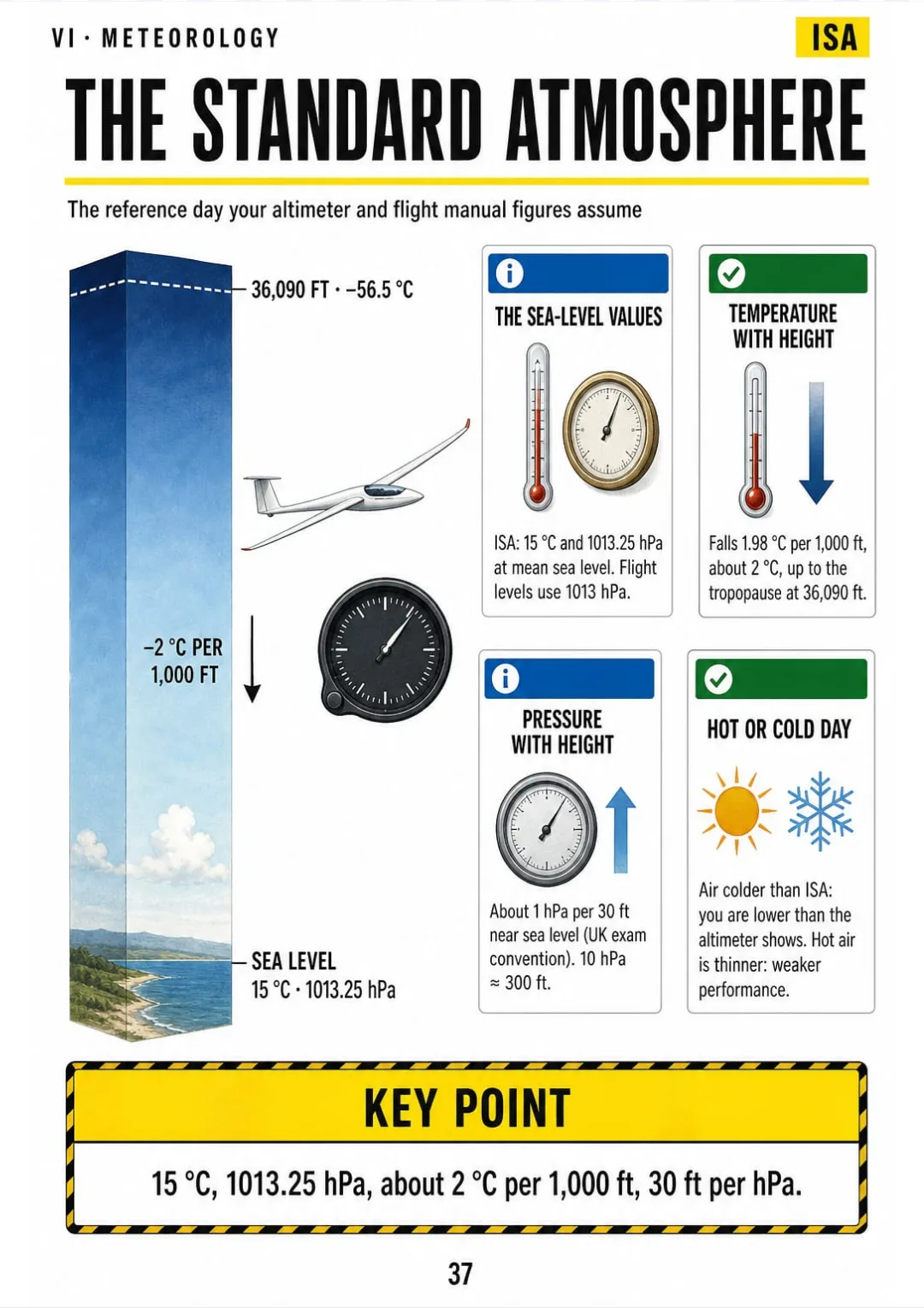
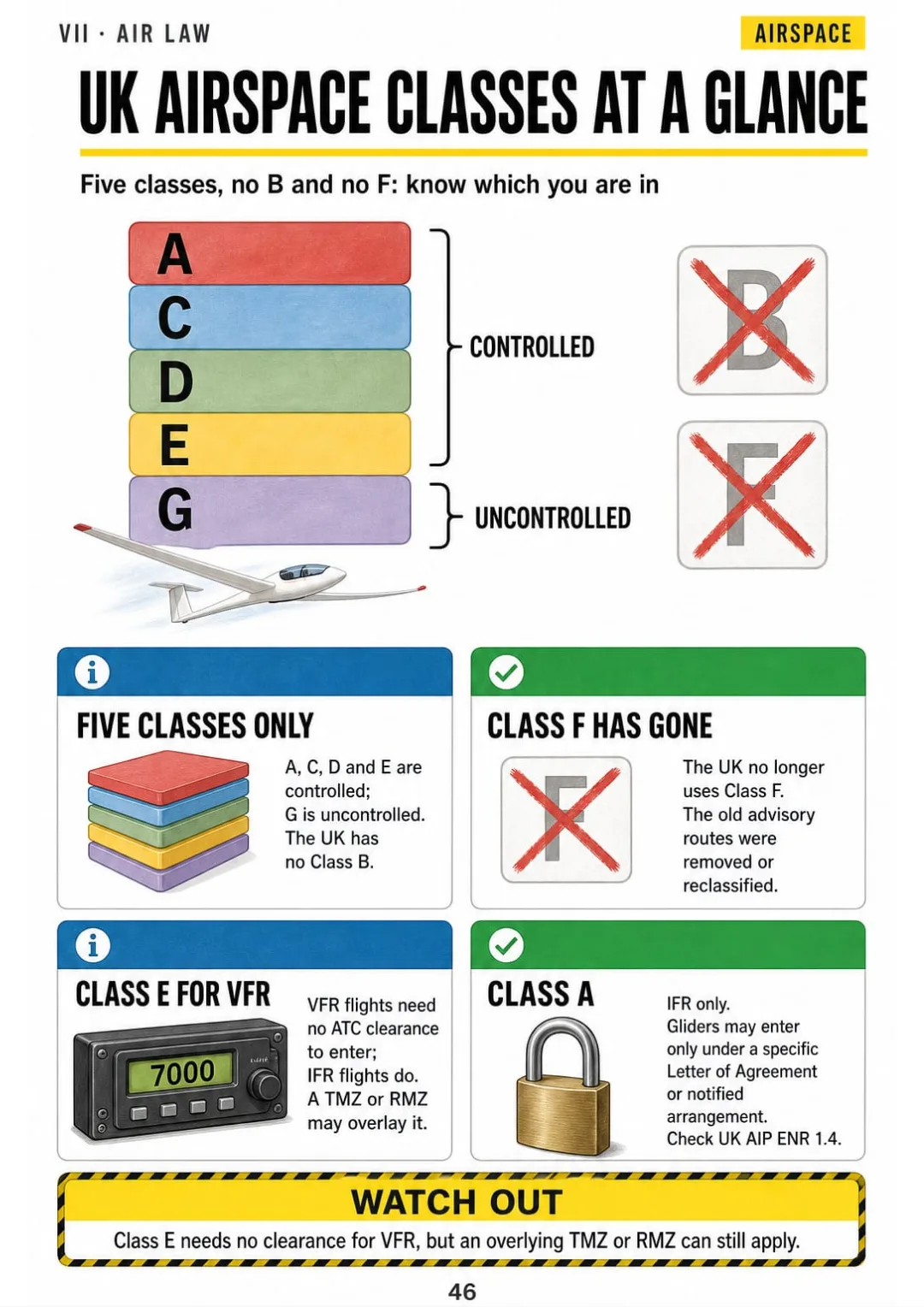
The forces triangle, the ASI colours, CB SIFT BEC, the standard atmosphere and UK airspace classes work the same way: each one has its own page.
So the next time someone asks about the polar, you picture the drawing and read the answer off it, without going back to the manual.

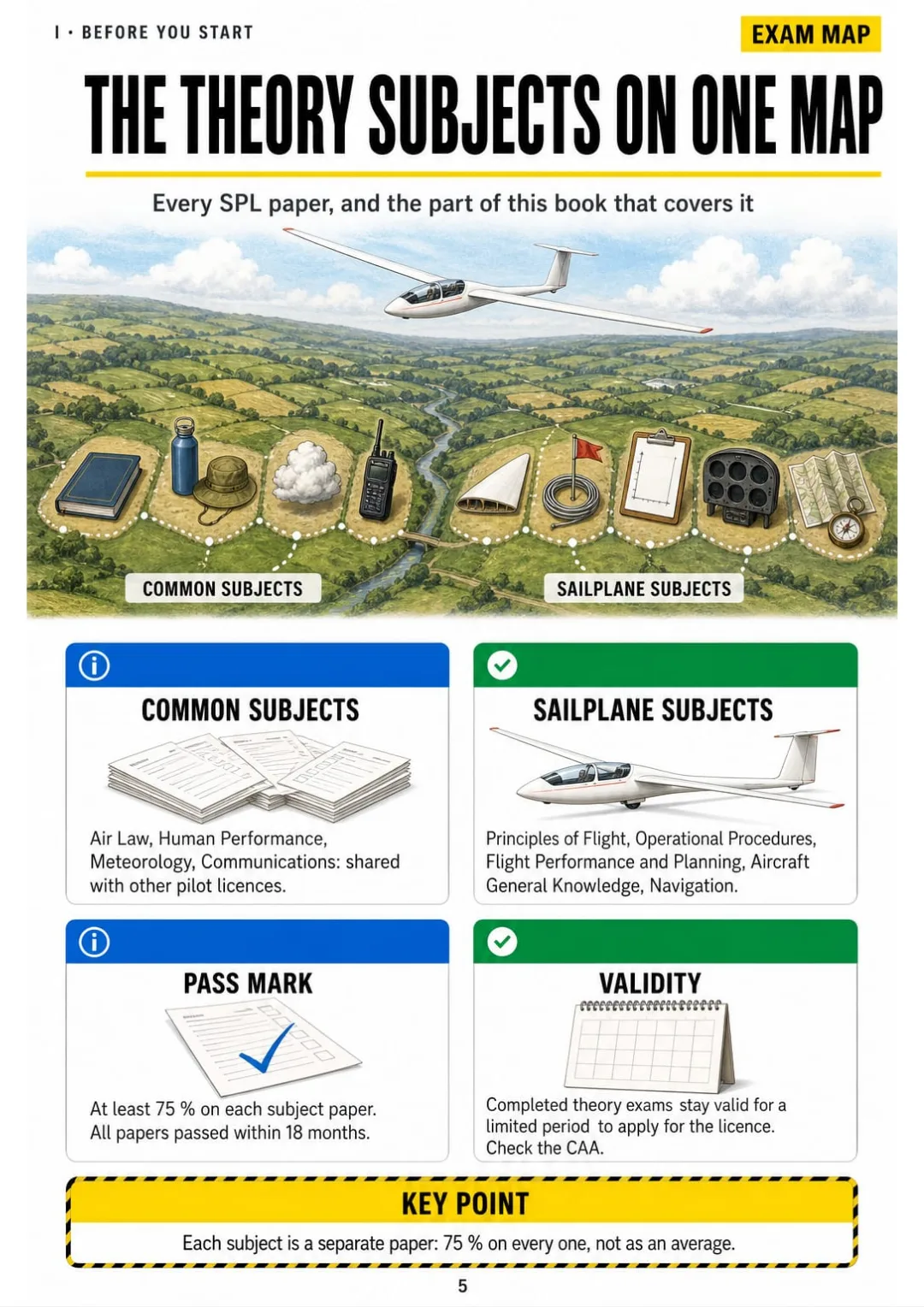
Before you start, principles of flight, performance and the polar, the glider and its instruments, launch, circuit and landing, meteorology, air law and radio, navigation and human performance, and final revision: 64 pages, all illustrated.
Think of it this way:
You're next in the launch queue on a winch day and the instructor leans in: "The cable breaks on the climb. What's the first thing you do?"
In the book you open the winch launch failure page and it's drawn in order: the nose lowered to the recovery attitude first, the release pulled twice, the speed checked, then the choice of landing ahead or flying a shortened circuit.

The same goes for the polar curve, the ASI colours, CB SIFT BEC, estimating cloud base and UK airspace classes: each one on its own page.
Glider Pilot Theory Illustrated is 9 parts and 60 topics, all drawn, with a final revision part: the numbers to know, the pairs that get mixed up and the procedures in their order.
What you see drawn, you don't have to memorize.
The nine theory subjects on one map, how to use one page a night and the units UK gliding actually uses.
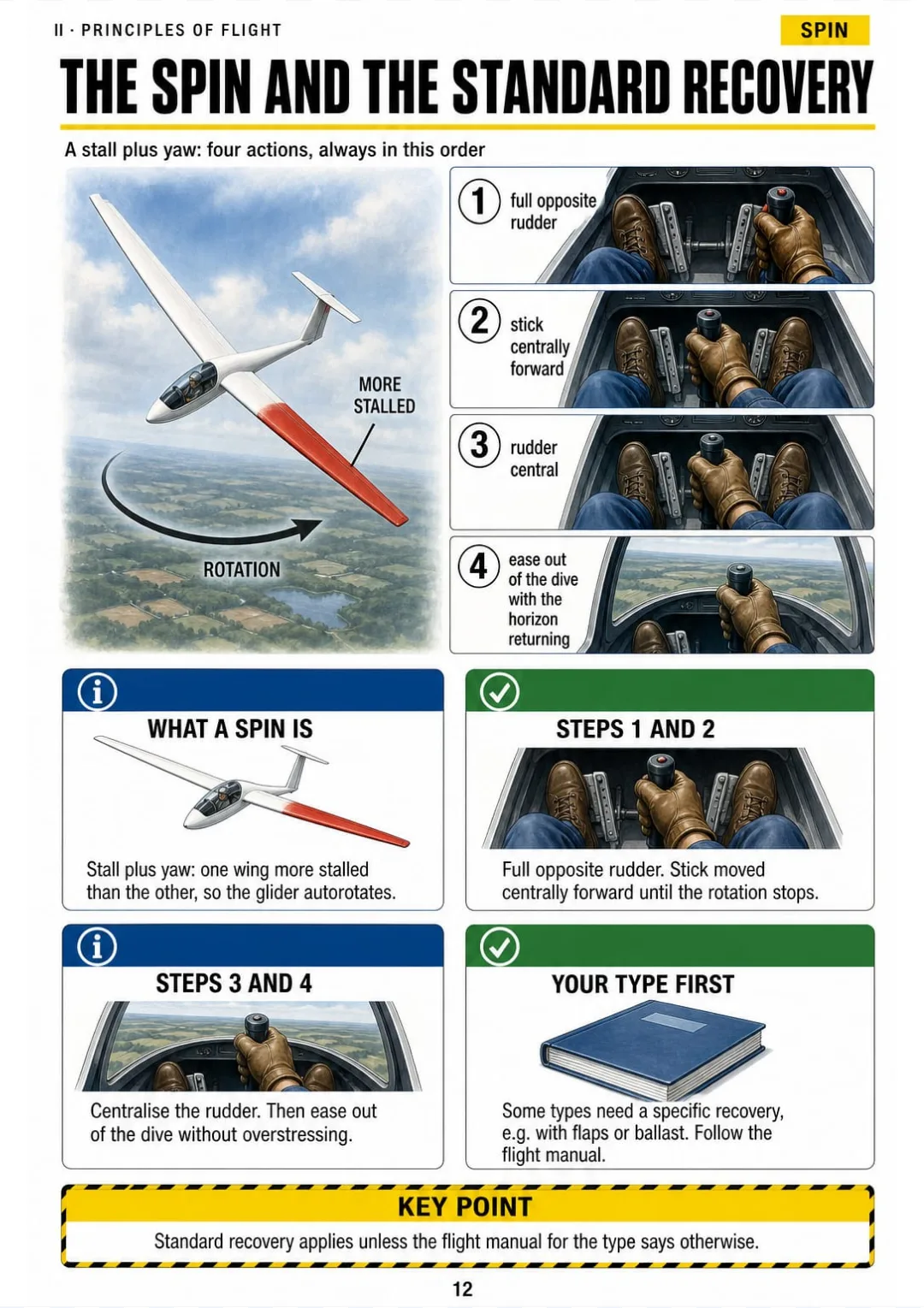
The forces on a glider, lift and angle of attack, the two kinds of drag, the stall, spin recovery, turning and load factor, stability, airbrakes and trim.
Reading the polar, best glide and minimum sink, flying faster in sink and headwind, speed to fly, water ballast and a worked weight and balance example.
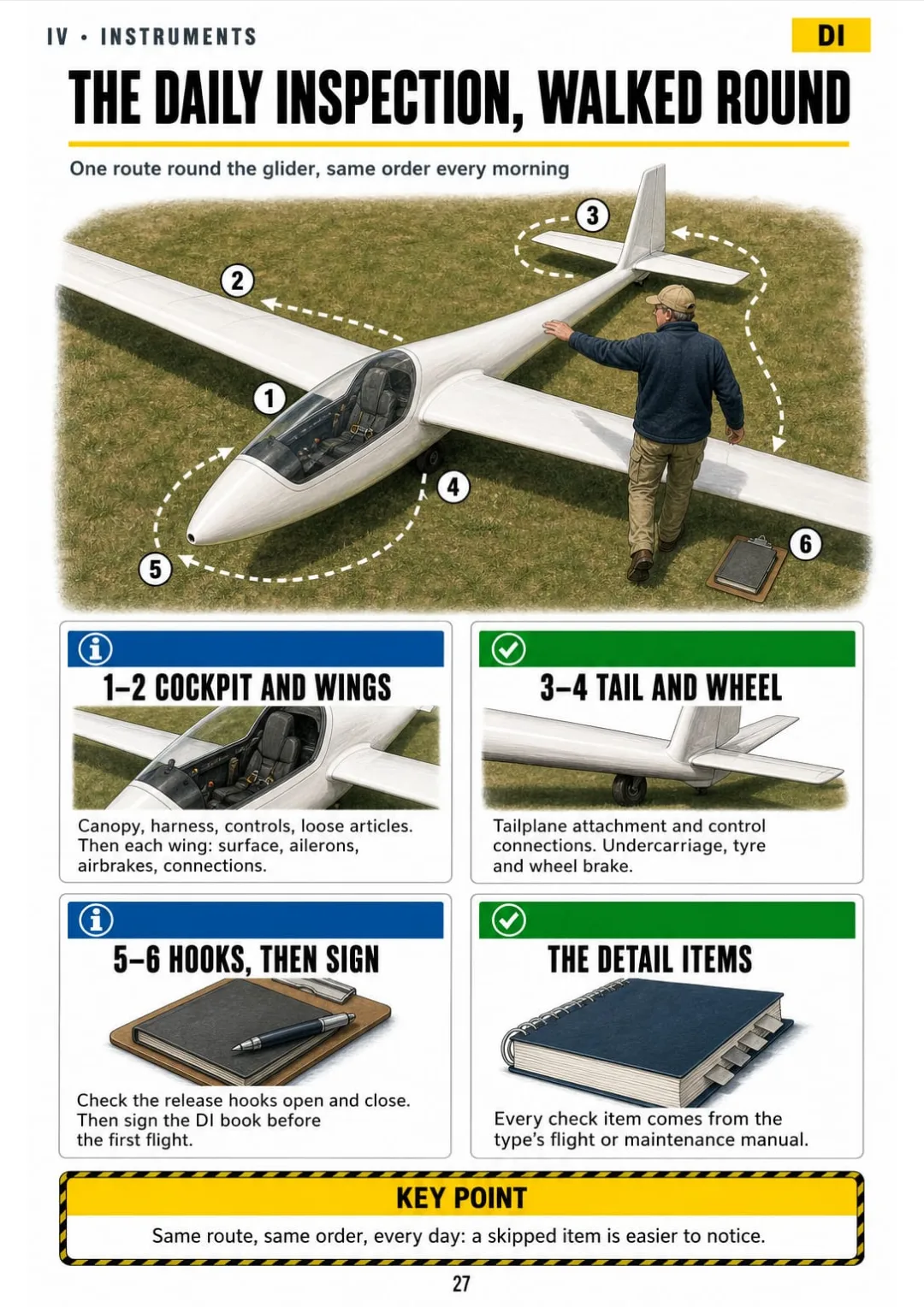
The ASI and its colours, the altimeter, the variometer and total energy, compass errors and the daily inspection walked round.
CB SIFT BEC, the winch launch in four phases, launch signals, launch failures, aerotow positions and emergencies, the circuit as a map, the approach and field landing.
The standard atmosphere, lapse rates, thermals and cumulus, cloud base, ridge lift, wave and rotor, fronts, sea breeze, METARs and TAFs.
UK airspace classes, VMC minima, right of way, ridge and thermal etiquette, QFE and QNH, ATZs and NOTAMs, licence and currency, radio calls.
The 1:500,000 chart, true, magnetic and compass, the wind triangle, the 1 in 60 rule, final glide, hypoxia and dehydration, lookout.
The numbers to know on one page, the pairs that get mixed up, the procedures in their order and the week before the papers.
At the end of the book: A final revision part: the numbers to know on one page, the pairs that get mixed up and the procedures in their order.
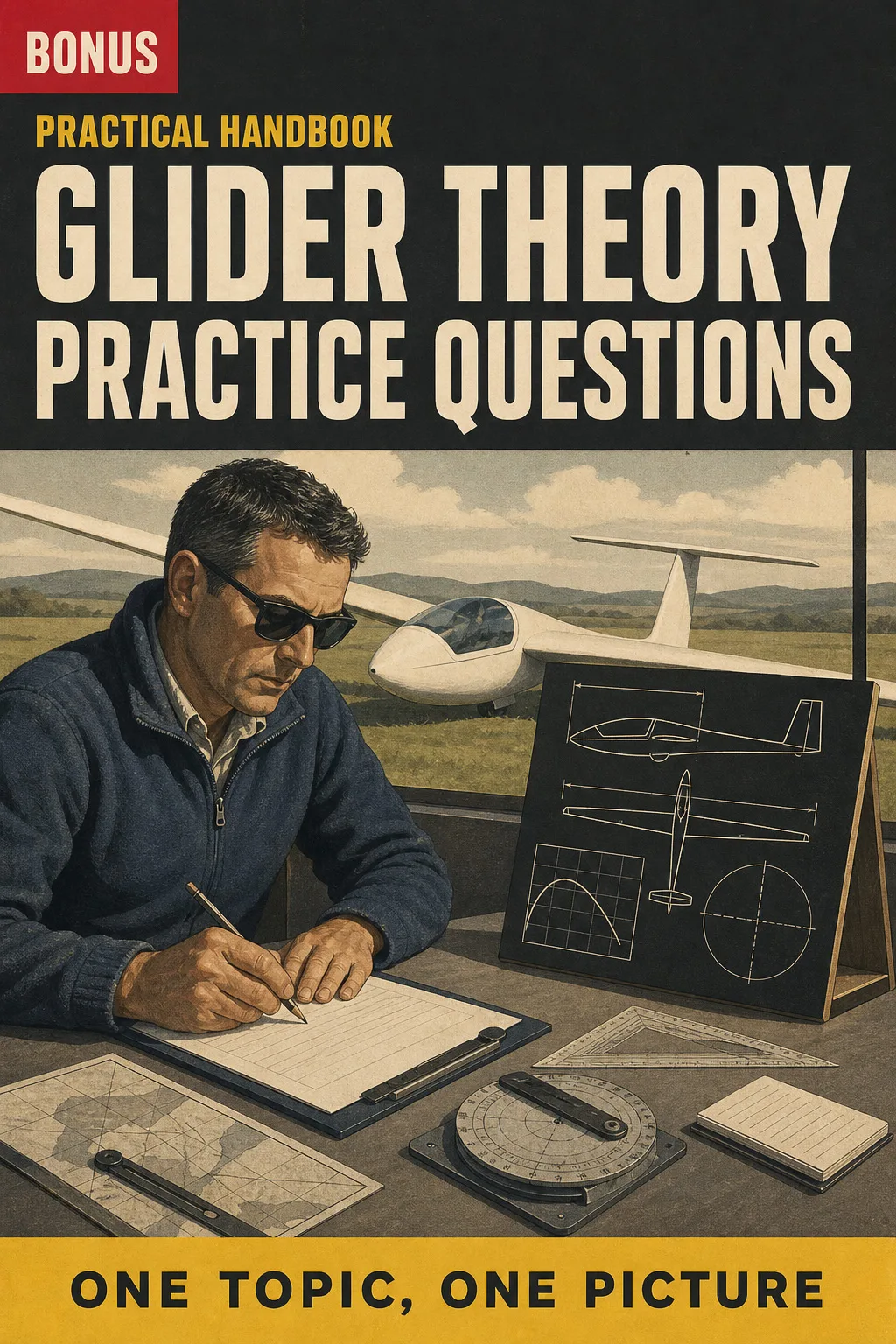
Exam-style questions for every subject, with the answer and a one-line reason, so you can see what you know before the real papers.

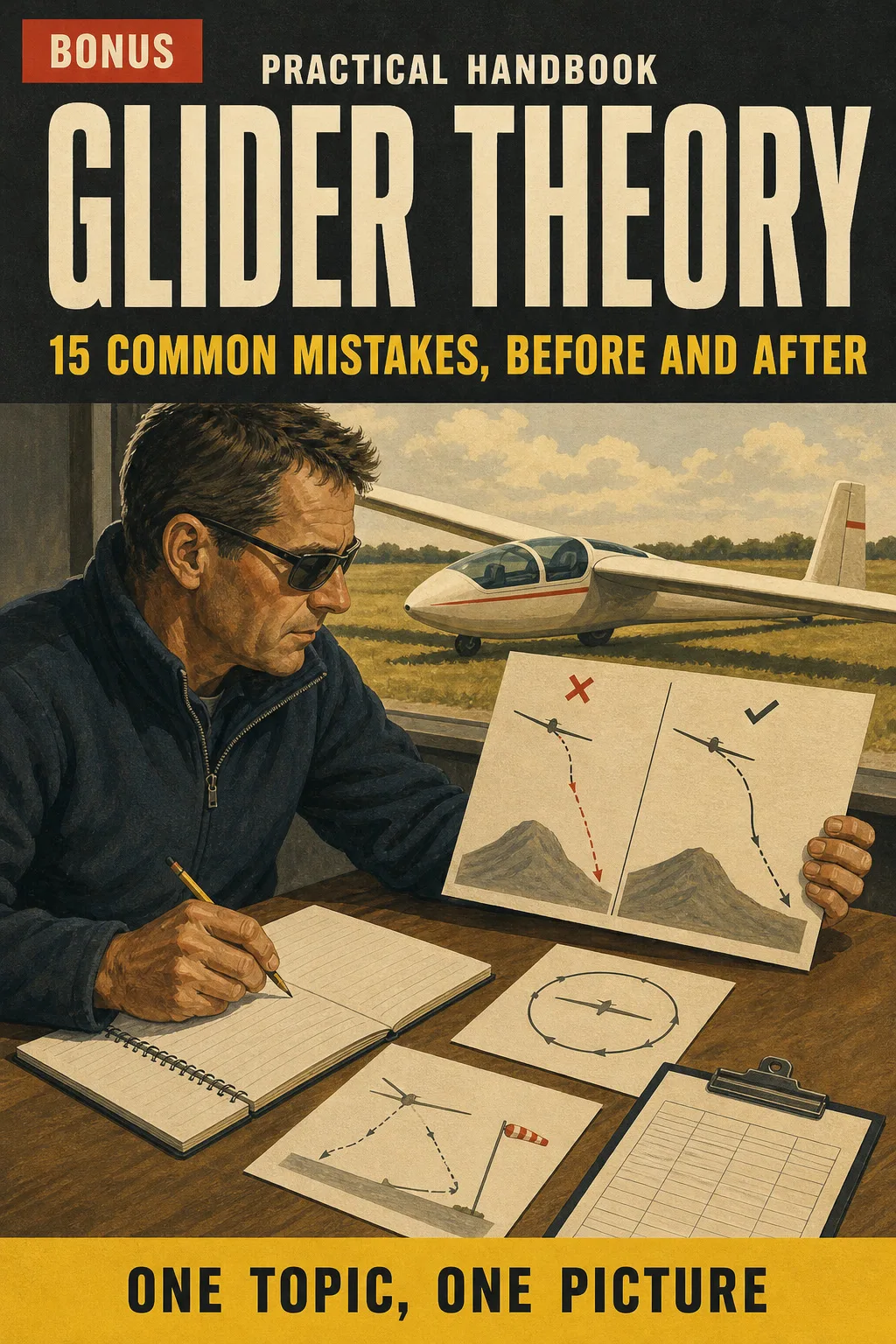
The mistakes students make most often, each one drawn wrong and then right, so you can go over the tricky points in one evening.
📄 This is a digital PDF book sent to your email: nothing is printed or shipped.
PDF by email: We email you Glider Pilot Theory Illustrated as a PDF, together with the two free books. It's a single payment: no installments, no extra charges.
Each thing you do in the air has its theory page: what you practised on the winch on Saturday, drawn so it still makes sense on Sunday evening.
All nine subjects in one place, in the same layout, plus exam-style practice questions so you can see where you stand before the real papers.
Airspace, rules and procedures as they are today, one drawn page at a time, so you can catch up without starting from scratch.
📄 This is a digital PDF book sent to your email: nothing is printed or shipped.
Try Glider Pilot Theory Illustrated for 30 days, bonus books included.
We refund everything if the file won't open, if the book isn't what you see here, if you were charged twice or if the email doesn't arrive. Just email us.
You pay once. No subscriptions.
Yes. It's written for club pilots before or after going solo, and for pilots coming back after years away. It doesn't treat you as a beginner: it puts the theory you half-know into order. Your manuals and videos explain in paragraphs; here each topic is one drawn page with its numbers and steps in a box, in the same layout across all nine subjects, so you can revise it in one sitting and print it.
It's checked against the current UK sources: UK Part-SFCL and its SPL theory syllabus, the Rules of the Air Regulations 2015 and UK SERA, the UK AIP and CAP 413. Gliding procedures are cross-checked with the gliding association's published rules, and type limits always come from your glider's flight manual.
No. It's an independent illustrated study book. It isn't published, approved or endorsed by the CAA or by any gliding body, and it doesn't give you a certificate or count towards your licence: you still sit the official theory papers.
No. It's for studying and revising the theory. Your instructors, your club's briefings and your flight training come first, and they decide when you're ready.
No. They're written for this book in the style of the theory papers, each with the answer and a one-line reason. They aren't official exam questions.
The book and the 2 extra books arrive as PDFs by email, to the address you enter at checkout.
No. It's a one-off payment, with no subscription.
Yes. The PDF is laid out to print at home or at a print shop, so you can keep it in your flight bag at the club.
You have 30 days. We refund everything if the file won't open, if the book isn't what you see on this page, if you were charged twice or if the email doesn't arrive: just email us.
No more rereading without anything sticking.
The polar curve: you see it drawn, and that's it.
You sit the papers knowing where everything is.
Drawings make studying faster.
The book is right below.
One-time payment: US$ 27 · Guarantee: 30 days · PDF by email
YES, I WANT GLIDER PILOT THEORY ILLUSTRATED FOR US$ 27📄 This is a digital PDF book sent to your email: nothing is printed or shipped.